
Healing crisis and cure are often linked in natural medicine, but much confusion exists.
 For the sake of clarity, this discussion of healing crisis will contrast conventional, science-based medicine with natural, tradition-based medicine.
Please keep in mind that these two approaches are not mutually exclusive, and that the patient receiving both conventional care and traditional care is likely receiving the best possible health care.
The series on healing crisis (you’ll find links to earlier articles below) started because a physician who is also a Reiki practitioner (not trained by me) asked for advice “how to deal with the emotional and physical healing crisis/cleansing effect.” He wrote that a healing crisis “can be very severe and even potentially dangerous in some vulnerable individuals.”
The conventional doctor’s confusion is understandable. He knows very well that the body has the capacity to heal itself. Physicians I work with often say most ailments they see in their offices would resolve without intervention if patients gave the body what it needs to recover (rest and appropriate nourishment).
Healing crisis or adverse reaction?
But doctors are trained to think in terms of adverse reactions and unwanted side effects rather than healing crisis and cure. When doctors see a patient feeling worse, they don’t think in terms of healing crisis, they see a disease state getting worse in a patient who needs care.
Physicians are taught to intervene to manage adverse reactions and reduce the likelihood of a negative outcome. And they’re taught to intervene earlier rather than later, hoping to minimize harm to the patient and prevent the situation going from bad to worse. (We won’t get into the unwanted side effects of aggressive treatment.)
A healing crisis, however, is not an adverse reaction in the medical sense. Rather, a healing crisis is an organic development of stimulating the body’s self-healing mechanisms.
Healing crisis and cure, and prevention
Healing crisis and cure aren’t part of the conventional medical paradigm. Healing crisis doesn’t occur in conventional medical treatment because conventional medicine attacks the disease directly. Rather than engaging the body’s self-healing, conventional interventions take over the fight.
Also, conventional medicine’s definition of cure is very specific. Once the relevant tests are clear, the patient is deemed cured. No attention is paid to healing the underlying causes of disease and degenerative conditions, as they are largely not detectable by conventional scientific tests (this is slowly beginning to change).
Traditional healing systems, however, have a comprehensive vision of cure and don’t treat the disease separately from the person. The goal of natural medicine is to restore the entire human system to balance; acute and chronic conditions are addressed within that context.
Healing crisis demystified
A healing crisis can seem magical, but it is decidedly not magical. It has a cause and it has an effect.
If a healing crisis happens, it happens as a natural consequence of strengthening the body’s own self-healing mechanisms. When the body’s self-healing mechanisms function more effectively, the body’s detox system is also functioning more effectively. If the system is detoxing faster than it is releasing, there may be a temporary exacerbation of symptoms. This malaise abates as soon as the system catches up to itself, at which point the person feels much better.
Healing crisis doesn’t happen in conventional medicine because conventional medicine treats the specific markers of a specific disease, rather than stimulating the human system to rebalance itself.
Beyond healing crisis: Hering’s Law
Nineteenth century physician and homeopath Constantine Hering observed the consistency of the body’s natural healing process and identified three elements in what is now called Hering’s Law:
- the healing process moves from the deepest, most subtle part of the system (emotions, mind, vital organs)
- symptoms reappear and disappear in the reverse timeline in which they originally occurred
- as healing progresses, symptoms move to the surface and extremities (skin, hands, feet)
If a person is consistently using natural medicine over a period of time, the specifics of the healing process described in Hering’s Law may be observed, especially if there is a continuing relationship with a traditional healing practitioner who is tracking the process.
If you have questions about healing crisis, please leave them in the comment section below. If you are reading this as an email, click the title to be taken to the website, where you can leave your question. Thank you for participating in this discussion.
Other articles in the healing crisis series:
Reiki Healing Crisis
Healing Crisis and Natural Medicine
Alternative, Conventional and Traditional Medicine
________________
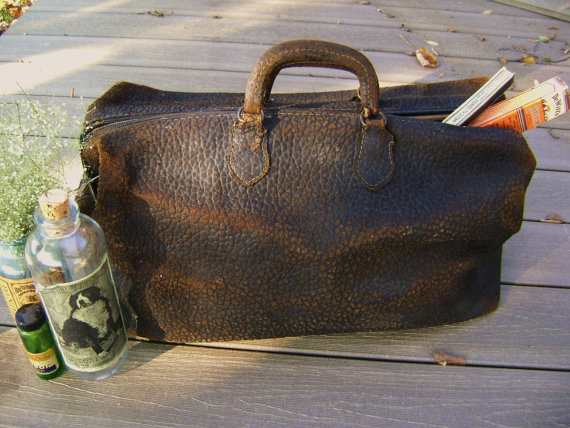
The vintage doctor bag pictured above is available from Etsy’s junquegypsy.
Sign up for the email list. Join here!

Hi Pamela, really liked your post! I started receiving Reiki a few months ago and underwent one healing crisis after the second treatment (had diarhea 24 hours after the treatment).
This monday I received another treatment and today experienced a kind of anxiety crisis (the reason why I decided to try Reiki) but with no severe taquicardia, which was one of the sympthoms I usually experience. I had all the other sympthoms (sweaty hands, increased intestinal and bladder activity, tremors and anxiety) but it was a bit different, like a calmer anxiety crisis. Could this be considered an healing crisis?
Debora, it’s possible. Did you feel better afterwards? Are you feeling stronger, steadier, less anxious overall?
Hi Pamela,
You don’t sound harsh, and I didn’t mean to overstep boundaries, either. My apologies if I did.
I certainly wouldn’t suggest anyone rely on the internet as an only source for information. Obviously, the internet has its limitations–but also it has its high points–for instance, your wonderful website and blog! I only suggested it in terms of searching for resources.
Pamela,
I just read Claudia’s last post. It sounds to me like Claudia experienced a kundalini awakening at the time of her attunement, regardless of the cause. Reiki may not have caused it, but the willingness to be open to new energies flowing through the body/mind may have made her susceptible to a spontaneous awakening. I’d like to recommend Claudia explore the phenomenon of kundalini awakening as a spiritual emergency (there are great websites and books). Sometimes this experience can resemble physical and psychological disorders, including anxiety. It can take a long time to integrate the experience–years, even–and deserves the appropriate support. Claudia, you may have already worked through it in your own way, but I bet it would be useful for you to contextualize it, and this might create space for you to see reiki was not the culprit. In fact, a healthy reiki practice would probably help someone resolve a kundalini crisis.
Rose, I know you mean well, and I do not mean to sound harsh, but I think you would agree that it’s important that this forum remain a safe place for everyone.
Maintaining a safe space requires us to limit the discussion to Reiki practice, respect boundaries, and steer clear of interpreting one another’s experiences. None of us are in the place of knowing what is happening spiritually with the other people in this community.
Kundalini is a profound topic that is traditionally taught in person by a highly accomplished master. I personally would not look to the internet for such spiritual guidance, not only because the information would likely be inaccurate, but also because this is an area where misinformation can be dangerous.
Hi Pamela,
I am sorry if I offended you by what I said. What I meant was that my teacher shared your view of “Reiki as a practice that helps the system balance ”
As for the attunement it was something like what Rose described. My eyes were closed during it so I am not sure what she did or didn’t do. I just remember feeling an intense heat and having a huge anxiety attack. I felt okay afterwards just a bit shaky. But the person who I spent the evening with that night said that I was very jumpy. I took a bath as instructed with a crystal and rose petals. I practiced Reiki on my self for the next 21 days. Then afterwards, I remember trying Reiki on my kids and husband. From that point it all went down hill. Maybe I did something wrong. I felt so ungrounded. I couldn’t sleep and so much fear just set it. It was so weird. I tried going to my Reiki teacher but she had very little to offer. She did Reiki on me, but things just got worse. I tried contacting other Reiki Masters but the same thing happened. Finally they told me to stop using Reiki all together. So I did. I even tried to contact the William E. Rand. He did provide me with some knowledge and said that I had help all around me, but it was so scary.
Anyhow – I was just trying to share my experience – I didn’t mean any offense. I have read other experiences similar to mine. I just wish that I could understand why it happens to some.
Claudia, you didn’t offend me at all. I apologize for whatever gave you that impression.
I’m just trying to help you understand that what you experienced doesn’t sound like Reiki practice as I know it. It all sounds very New Agey to me. I’ve never heard of taking a bath with a crystal and rose petals. To my training, daily self-treatment continues for life, not just 21 days. The Reiki master might have said that Reiki is a balancing practice, but perhaps she has not deeply contemplated what that means.
From what you have shared here, I don’t see anything that you did wrong.
I have occasionally heard of other people having bad experiences. Without pointing a finger at any particular Reiki master, I know that there are people initiating others after very little training and experience, others who pass dubious initiations, and some who mix up Reiki practice with shamanism and other aggressive energy techniques. In all those cases, it seems to me that the problem is likely traceable back to the Reiki “master,” not the student. As I often say, Reiki practice is safe, but is the Reiki practitioner safe? If a master has not had a daily practice of self-treatment for years, and ample training and clinic experience before starting to teach and initiate, the answer to that question is more likely to be “No,” meaning he/she cannot hold a clean space for initiation and/or he/she gets subtly aggressive when initiating and treating instead of allowing the process to unfold naturally.
Thanks, Pamela. I read the other blog, and it was very helpful–especially clarifying the difference between being attuned to energy vs. initiated into a practice.
Pamela,
Thanks for the quick reply. That makes sense…I didn’t pick up on the fact the symptoms started a month later. I know a woman whose husband became psychotic shortly after taking a reiki training, and she insisted he’d actually become demonically possessed!
Thanks for the article link. How in heavens name did initiation get replaced with attunement in the first place?
And for all we know, Rose, the wife might be right. Who knows what happens in these situations?
It would seem that that word attunement came from a misunderstanding of the initiation process, specifically the mistaken idea that people need to be attuned to “the Reiki energy.”
Pamela,
Is it possible Claudia’s response was a healing crisis that for some reason didn’t resolve? Or, for some reason, took a very long time to resolve?
Also, I was surprised by your comment that you didn’t know what she meant by getting an attunement. When I taught years ago, I always “gave attunements,” because that’s what I received from my teacher. It was a ritual that reminded me a bit of the laying on of hands during confirmation in the Christian tradition. I saw it not as imposing something on a student, but as a way of supporting the student in making his or her a connection with reiki energy.
However, next spring I’m going to be teaching a reiki class in a hospital setting to cancer patients, and I’m not as comfortable with this same process–I suppose because in some ways it seems quasi-religious to me, and I’m not sure it would fly. Do you have any thoughts on that for me?
Rose, a healing crisis starts much sooner than a month. Claudia is feeling better, so it appears that whatever was happening has resolved.
Attunement is a New Age word used instead of initiation, the word Mrs. Takata used. I give initiations; a First degree Reiki class is not complete without the four initiations.
Initiations enable students to practice Reiki. It’s that simple. It’s not religious; it’s a traditional way of introducing students to a spiritual practice. Please click here for an article that goes into this in more detail.
Thanks for the article. It was very interesting.
I still don’t know if this is what happened to me when I got my reiki attunement – but about a month into it I had some awful symptoms of insomnia, heart palpitations, weight loss, anxiety, and irrational fear. It lasted almost one year and it was just awful. I have never experiences anything like this before. I felt like I had made the biggest mistake of my life being attuned. I will never really know what happened but I do caution people to know what may happen before working with energy. I hope that what I went through was healing, but the whole experience made me sad on a very deep level. I feel like there was a trust that I had in life that I don’t know if I will every get back.
Claudia, what makes you think this was related to your Reiki practice? Is it possible it would have happened anyway?
I also think this points to the difference between Reiki as a practice that helps the system balance — which is how the practice started — and what it has become in some circles, a more aggressive energy-work intervention. And I agree with you, messing with energy can have serious repercussions. Practicing Reiki is very different because it helps the system restore balance and self-heal.
Hi Pamela,
Yes you are correct I don’t know if it was reiki or if something else happened. That is why I state that I will never know.
The best way that I could describe it is that energy got stuck in my Thyroid. The interesting thing is that I did turn to physicians and they could never find a cause. It was like I was perfectly healthy (thank god), but yet had this crisis.
I wanted a Reiki attunement because I thought that it might be a way to help myself heal and to hopefully help others. But I don’t know if I just became so sensitive to everyone and everything around me that it affected me negatively. I tend to be very empathic to begin with so this may have been too much for me. But I wish that the practitioner who seemed to share your views on Reiki would have had a way to discern whether or not I was ready. I even had the worse anxiety attack while the attunment occurred. It was a very weird experience. We did it as a group – so I often wonder if everyone else’s energy affected me.
Anyhow – hopefully I am on the mend now – after a lot of work with meditation. I tried to go back for Reiki treatments, but I don’t react very well to them anymore. It is so weird.
Conventional medicine often cannot detect a problem, and in some ways that is a good thing, such as if it means there is not yet any discernible physical pathology.
You refer to getting a Reiki attunement. I honestly don’t know what you mean. I only give the four First degree initiations within the context of a proper class that lasts about 10-12 hours over 2-3 days.
And when giving initiations, I’m not doing anything to the students. Rather, I am sharing with them the ability to practice Reiki. Many Reiki masters, especially those who are not well trained and experienced, approach initiation as an intervention, and frankly, who knows what they are doing.
What made you think the practitioner shared my views on Reiki? Since there are no standards for Reiki education or practice, it is truly a buyer’s beware situation. This is particularly challenging to the public because they don’t know enough to know if a practitioner is qualified or not. That’s why I wrote this article https://reikiinmedicine.org/popular/reiki-classes-right-for-you, to give people the information they need to evaluate a Reiki master.
But I can say that from a Reiki practice perspective, the sentence “I tend to be very empathic…so this may have been too much for me” doesn’t make sense. True Reiki practice is balancing and people naturally become more grounded and have better boundaries as they practice daily Reiki self-treatment.
I am glad you are feeling better and very sorry that you had such a bad experience. I hope you will consider that your unfortunate experience is not representative of true Reiki practice.
Rose, the healing crisis mentioned in the interview lasted hours and was not life threatening. If yor cat had been having a healing crisis, he would not needed intervention. We don’t know what caused his unfortunate health crisis, but fortunately you intervened in time.
I agree with the doctor that there are times a healing crisis can be dangerous. Years ago I had a cat who went into a healing crisis that was so severe she almost died of kidney failure. The miracle of it was that literally in the nick of time the homeopath prescribed another homeopathic, and within a few hours she was almost completely back to normal. So…I respect healing crises!!!
I had a client once who had a healing crisis for forty days. She had constant diahrea. I was very nervous about it, and wanted her to see a doctor, but she refused. She stuck to her guns, convinced she was ridding herself of years of rage at her mother. I was soooo relieved when that cleared up!
Finally, I was really intrigued by the story on the recent webinar when David said his wife had an extreme response–vomiting and diahrea–and they weren’t sure what it was, but trusted Mrs. Takata’s perspective. I think it’s very frightening and unnerving for most of us to trust something may be a healing crisis that will pass when the symptoms look so much to the contrary.
Rose
Love this post, Pamela – great approach, well explained. Like it so much you’re in my top 10 Reiki posts this month!
Thank you so much, Fiona. Always good to hear from you!
Thanks so much for all your words of wisdom!! I will write back next week following my return visit)
p.s My Auntie is actually my Dad’s cousins wife so not too close family wise & normally I only get to see her once or twice a year..but always called her Auntie. She is a wonderful person & has always shown an interest in Reiki & spiritual matters so when I heard she was ill I visited her & she said she would love to try a a Reiki treatment.
Since treating her I have found the, idea of visiting someone poorly & housebound (and enabling the carer to “get out” for a few hours) very rewarding and enjoyable & have been thinking of carrying on “Respite Reiki” in the Community , early days but something I truly enjoy.
love Holly x
Got to das
Thank you, Pamela. What a beautiful quote!
I think the non-doing, and not “working” on people is the greatest potential of Reiki practice. We offer acceptance to our clients. We are not trying to fix anything about them. Thus we allow the person to experience their wholeness, no matter what they are going through.
Thanks Pamela , Great to find some information regarding “flare up” (Crisis following Reiki treatment) .
At present I am treating my terminally ill auntie at home, she sadly has a condition called MSA (Multi Systems Atrophy) .
After her 1st treatment she looked glowing & was very relaxed, her tremor went & her strained/ gasping breath returned to normal, however after day 2 or 3 she suffered acute widespread pain & was prescribed Morphine…this made very very sleepy & decreased her mobility even more than before.
She came off the morphine yesterday (as she struggled to talk on it) and welcomed another Reiki treatment today.
Again after 5 mins her severe tremor in both legs stopped & her breathing relaxed (at one point I had to check she was still breathing, it was so gentle !!) again, great instant relief from her symptoms.
I felt I needed to investigate why she had such pain (was it the Reiki ?? i knew my Uncle worried it was) I’m so revealed I came across your information & have printed it for them to read (hope you don’t mind??)
I have been practising as a Reiki Practitioner for over a year now & have only come across this once before, ironically another aunt (with a shoulder problem) she said she was up all night with pain following my treatment.
It’s a shame I didn’t think to look for your page then, as I wasn’t able to give an explanation to her & I feel this has put her off of further treatments.
Many thanks again, fingers crossed my Auntie doesn’t have such a painful crisis this week.
Kind regards Holly
Holly, thank you for taking the time to write. It’s always so good to hear that my writing has helped. There is so much unnecessary suffering due to lack of information, and it is understandable that people who are new to Reiki can get frightened when things don’t go as they expected.
It can also be more complicated when we are treating family members and friends, as there is more emotionally at stake. Please take care to steady yourself before and during the treatments, and allow the Reiki practice to do what needs to be done and what can be done. Healing with Reiki treatment is more about the person’s system than it is about the Reiki practitioner.
Holly how scary for you to be confronted with this period of healing adjustment aka “Crisis” with your Aunts. I don’t know how Pamela feels about this but it has been my understanding that when pain increases during a treatment it is important to keep doing Reiki even if it is above the body and the pain will usually well up and subside. This is of course if the person you are working on is willing. I have found in my practice that it does help to keep doing Reiki at a point from the body where the discomfort starts to subside. It can be human nature to start doubting ourselves when pain intensifies ,but, keep doing Reiki if the person is still willing and hopefully the energy itself will take care of the doubts.
Maribeth, what do you mean by “doing Reiki”?
For me, Reiki is all about non-doing, and offering a space to another person where healing may take place – according to the person’s innate self-healing ability. When we see ourselves as doing something to another person, we feel responsible for the outcome of the treatment.
I would like to share my experience with treating family members. My husband had a brain tumor about a year ago. When I was in the ICU with him, my plan was to give him Reiki treatment as much as possible. However, I was not able to do it. I found myself being too anxious and unbalanced, too attached to wanting the Reiki treatment to do something in order to make my husband feel better.
I sat down next to his bed and began to self-treat. We both fell asleep and woke up two hours later. Self-treating was the best thing I could have done for my husband – and myself!:)
Christine, thank you so much for this comment.
It’s so easy for westerners, and perhaps especially people in the US, to go down the “doing” road. We are used to working hard.
But practice isn’t work, it’s balanced action. We place our hands and keep them there — that’s pretty much the extent of the outer work.
The inner work is more about self-restraint, “not-doing” so that the practice has full rein. When we are in “doing” mode, no matter how subtly, we are in danger of over-stepping boundaries on so many levels.
I have long loved this quote from the Tao te Ching, which is so relevant to Reiki practice:
Less and less is done
Until finally
When nothing is done
Nothing is left undone.
Maribeth, you also made a good point. Although it’s very important to address each situation individually, I agree that offering more treatment often helps the person go through whatever they are going through more comfortably, but it can be a hard sell if the person has decided that the Reiki treatment itself is making her sick and doesn’t have a larger understanding of healing. For this reason, it might be wise to offer less treatment in the beginning. We will address this later in the series on healing crisis.
Thanks for this post, Pamela! I find myself sometimes hesitant to talk to some people about healing crisis (I find myself saying “period of adjustment” more often), due to the sometime alarmist response that can come up, depending on the person.
When I first “learned” Reiki, I must admit that I was angry at my body for going through the healing crisis; now that I’ve gone through several, I always try to remember to thank Reiki and my body for the purification, balance, and communication.
I agree with you about the term, Chris, and only use it because it is already so well known.
Do you think that the anger you felt was part of your healing crisis?
Oh, no doubt, there was definitely an anger cleanse (as well as a huge emotional cleanse in general) was *definitely* a part of my first healing crisis.
However, even though it was explained by my Reiki teacher, I didn’t really understand the healing crisis then – what it was, why it was there, why something that was supposed to be healing was hurting me – so I suppose I was a little angry at Reiki itself, too.
I’m thankful for that experience, now; it definitely is helpful to be able to walk people through their own crises.
I agree, Christine. As a spiritual healing practice with no medical contraindications, Reiki practice can support people stay healthy, or while they undergo even arduous conventional medical treatment. People can also practice Reiki even though they may be receiving other traditional medical treatments such as acupuncture or herbs.
Hi Pamela this is another of your very interesting articles on Reiki. As a Registered nurse this article was particularly interesting. Since I am in the medical field as well as a Reiki teacher I have been able to personally observe the importance of Reiki in and out of the medical setting A couple of things that I am hoping you will clarify is the adjective use of conventional versus traditional when writing about Traditional medicine as I know it as a Registered nurse versus complementary medicine ( of which Reiki is a part) which you refer to as Traditional. This can be a very confusing way to delineate the the two to the reader since Traditional and conventional are both used to describe medicine that treats disease symptomatically as stated so well in your article. Food for thought since many explain the two as Traditional and complementary. Since you are in a position to connect with many others through your wonderful Reiki networks I was wondering if you could help me with this if you in fact agree. I have never liked the term crisis when it was used in my Reiki training. Crisis has an OH-OH factor to it like something bad is happening when you and I as well as other well trained Reiki professionals know that it is part of the healing process. Could we perhaps find another word than crisis to explain the occurence of healing symptoms. In my mind and my personal observations there is nothing bad about Reiki so to have healing “crisis” denotes a scare factor which can cause unnecessary concern. I have had this talk with other Reiki teachers who have felt the same way. If anyone could come up with a better way of expressing this you can. Thankyou Pamela!
Marybeth, thank you for your comment and your vote of confidence. :-)
To clarify the terminology — conventional medicine is based on medical science; traditional medicine is based on healing traditions. What has come to be called complementary medicine is basically a subset of traditional medicine, but traditional medicine predates conventional medicine.
People in conventional medicine often mistakenly refer to what they do as traditional medicine. It’s a bit medico-centric in the sense that people who do that are ignoring the thousands of years that traditional medical systems such as Ayurveda, Native American medicine, Chinese medicine and African medicine were practiced before Descartes took medicine down the science road.
“Healing crisis” is a term that has a long history in natural medicine and is widely recognized among professionals. That doesn’t mean we have to use that term when speaking to our clients. We’ll consider ways to communicate with clients later in the series.
This is a great post. Thank you, Pamela.
I think Reiki practice is a great adjunct to conventional, as well as to complementary and alternative medicine.
Pamela, thank you so much for doing this series on Healing Crisis. It has come up and I address it in a very similar way. Those who may experience them need this kind of information available.
p.s. I’ll be in San Juan the week before your seminar! Just missed each other. :)
So sorry to miss you, Eileen. I arrive Feb 20.
Thanks for this great explanation, Pamela. I know that as a person brought up in the conventional medicine model, I have had times in the past (and, sometimes even now) where when new symptoms presented themselves, I would want them gone asap! Now I am learning to trust the times of healing crisis and to welcome them as a sign of deeper healing when I am working with a holistic practitioner.
I agree, Ellen, and by settling our systems and increasing our awareness in the moment, daily Reiki practice helps us know when our bodies need to rest while they work something out, and when we need to intervene. And of course staying calm even when we’re uncomfortable helps us heal faster.